Gorakh Hill Station, Sindh
"Gorakh Hill Station"

Gorakh Hill station located near Dadu sindh, lies at the altitude of 5,688 feet above the sea level. It has the temperature in between 15 and 16 degree centigrade even in the summer season. — at Gorakh Hill Station, Sindh, Pakistan. Due it's surroundings, it is a unique adventure point for nature lovers. Gorakh Plateau also serves as gateway for the villagers of Khuzdar District.
Kirthar National Park, Sindh
"Kirthar National Park"


The Kirthar National Park is situated in the Kirthar range mountains in Karachi and Jamshoro District in Sindh, Pakistan. It is the second largest National Park of Pakistan after Hingol National Park. The fauna comprises leopards, striped hyenas, wolves, ratels, urials, chinkara gazelles and rare Sind wild goats. Blackbuck antelopes are kept in enclosures for a reintroduction project at Kirthar National Park.
Hingol National Park, Balochistan
"Hingol National Park"

Hingol (Hungol) National Park is the largest of National Parks of Pakistan and lies on the Makran coast in Balochistan, Pakistan.

Hingol National Park is known to support at least 35 species of mammals, 65 species of amphibians and reptiles and 185 species of birds. Some 250 plant species were recorded including 7 yet undescribed species. Many more species are yet to be collected. The park forms an excellent habitat to wild Sindh Ibex, Afghan Urial and Chinkara Gazelle.

This rock formation resembles the Great Sphinx of Giza. This Sphinx, however, is a natural one that was sculpted by coastal semi-desert winds for millions of years.

It got Mysterious Mud mountains, beautiful blue water Hingol river, desert and deep blue Arabian sea.
Port Fountain, Karachi
"Port Fountain"
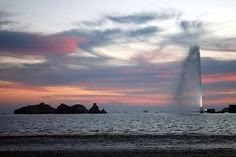
Port fountain is world third tallest fountain located at Karachi.It was constructed in 2006 and it jet water up to 620 feets above sea level.It is a sight to enjoy from every vantage point on the Clifton Beach with illumination at night. The fountain is an icon for Pakistan and symbol of its development and is a gift from KPT (Karachi Port trust) to the citizens of Karachites.
HISTORY OF HYDERABAD
HISTORY OF HYDERABAD

Hyderabad, as the historic capital of Sindh, is the centre of all the provincial communications: road, rail, waterways and air. From the date of its foundation (1768), its manufactures-ornamented silks, silver- and gold-work, and lacquered ware-have been the chief in the province, and during its heyday had gained prizes at the industrial exhibitions of Europe. Some noteworthy antiquities are the tombs’ of the Kalhora and Talpur rulers.
The early Hindu settlement in Hyderabad
Under the rule of a Hindu ruler Neroon, (Nairon) this small fishing village thrived upon the banks of the mighty Indus river. A nearby hill tract called the Ganjo Takker or the bald (barren) hill, later attributed to as the Ganjo Range by British, protected the town raising it above the level of the water and safe from flood calamities that were regular in neighboring regions. The place came to be known as Neroon Kot. literally means the Fort of Neroon.
The Ganjo Takker ridge lay on a low limestone range and was used as a place of worship by the most adherent religious priests that blessed the city believing their meditation may result in excellent trade networks the city was developing at the time. But these very particular popularity traits in the areas of trade led the city vulnerable to outside sieges. Equipped mostly with farming equipment. In 711-716 the place was attacked by the Arab armies locals surrendered & Neroon was dethroned.
The Islamic conquest
Arab General Muhammad Bin Qasim leading his troops conquered the town in 711-712 AD. By the mid-712, Muslims armies had conquered much of the Sindh. However, later in an agreement with local Hindu authorities of the Sindh the Arab forces halted their advances and ceased military activities in Sindh in return of peaceful conduct affairs. After a brief rule of Arabs and Hindu leaders Sindh came under the rule of local Sumras, who were local Sindhis converted to Islam. Somra rule was followed by the Samma dynasty rule. By the end of Samma dynasty rule Sindh was occupied by invading Afghan warlords who lost the empire to Mughal Empire after a brief period of rule.
The Mughal empire thrived in the majority of the central parts of India and yet however never seated a ruler on the land of Neroon. The new Muslim invaders that had settled in the town mingled with the locals and wed Hindu girls and were pulled into the mysticism of the land. For decades Hyderabad did not seat a throne but things were to change when Nadir Shah Durrani or Iran invaded the Mughal capital in 1739.
All throughout the late 1600s, the Mughal dynasty had grown weary and weak in the regions of the Sindhu territory or Sindh and the governor Yar Muhammad Khan Kalhora became the de facto, virtual ruler of Sindh around 1701 CE. Muhammad Khan Kalhora belonged to the most affluent tribe in the region namely the Kalhora
Continue reading at -->
http://usmanhashmi.wordpress.com/2014/01/29/history-of-hyderabad/
http://usmanhashmi.wordpress.com/2014/01/29/history-of-hyderabad/
Subscribe to:
Posts
(
Atom
)